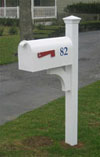
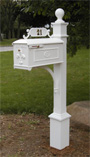
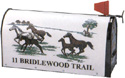
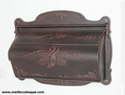
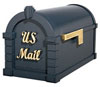
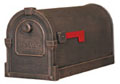
Every once in a while someone asks about USPS regulations governing the delivery of mail. We have reprinted here for your convenience the rules for mail delivery, mailboxes, mail slots, and mail posts as stated on the United States Post Office Web Site.
2.0 Conditions of Delivery
2.1 City Delivery Service
2.1.1 Establishment
City delivery is provided according to USPS policies and procedures, the characteristics of the area to be served, and the methods needed to provide adequate service. Requests or petitions to establish, change, or extend city delivery service must be made to the local postmaster.
2.1.2 Accommodating Customer Hardship
Changes in the type of delivery authorized for a delivery point may be considered if service by existing methods imposes an extreme physical hardship on the customer.
2.1.3 Customer Maintenance of Receptacles
Customers must provide authorized mail receptacles or door slots, except for mail receptacles authorized by the USPS to be owned and maintained by the USPS. The purchase, installation, maintenance, and replacement of mail receptacles used by customers for mail delivery are not the responsibility of the USPS. However, the USPS may authorize neighborhood delivery and collection boxes and parcel lockers to be purchased, installed, maintained, or replaced by the USPS.
2.1.4 Businesses
Mail receptacles or door slots are not required at businesses and offices that are open and have someone on hand to receive the mail when the carrier calls.
2.1.5 Receptacles With Locks
If a lock is used on a mail receptacle, the receptacle must have a slot large enough to accommodate the normal daily mail volume.
2.1.6 Door Slot
A door slot for mail must meet specific criteria:
a. The clear rectangular opening in the outside slot plate must be at least 1-1/2 inches wide and 7 inches long.
b. The slot must have a flap, hinged at the top if placed horizontally, or hinged on the side away from the hinge side of the door if placed vertically.
c. When an inside hood is used to provide greater privacy, the hooded portion must not be below the bottom line of the slot in the outside plate if placed horizontally, or beyond the side line of the slot in the outside plate nearest the hinge edge of the door if placed vertically.
d. The hood at its greatest projection must not be less than 2-1/16 inches beyond the inside face of the door.
e. The bottom of the slot must be at least 30 inches above the finished floor line.
2.1.7 Apartment Mail Receptacles
Apartment house mail receptacles must be approved by the USPS. The purchase, installation, maintenance, and replacement of mail receptacles, boxes, or parcel lockers are not the responsibility of the USPS except for neighborhood delivery and collection boxes and parcel lockers authorized by the USPS to be owned and maintained by the USPS. When apartment buildings are substantially renovated or remodeled to provide additional apartments, or a material change is made in the location of boxes, obsolete receptacles must be replaced by currently approved receptacles.
2.2 Rural Delivery Service
2.2.1 Establishment
Rural stations and branches are established, and rural delivery is provided, according to USPS policies and procedures, the characteristics of the area to be served, and the methods needed to provide adequate service. Requests or petitions to establish, change, or extend rural delivery service, signed by the heads of families wanting this service, must be given to the postmaster of the post office from which delivery service is desired, or from which the route operates, as applicable.
2.2.2 Accommodating Customer Hardship
On the customer's written request, the postmaster may approve an exception to the currently authorized method of delivery, if the type of rural delivery authorized imposes an extreme physical hardship.
2.2.3 Parcel Delivery
An ordinary parcel too large to fit into a customer's mailbox is not left unless the customer has filed a written order with the postmaster relieving the USPS and carriers of all responsibility in case of loss or depredation of any such parcel left outside the box.
2.2.4 Delivery to Recipient With Contagious Disease
Mail is delivered to a customer's mailbox if a quarantined disease exists, provided that delivery can be made without exposure to contagion. No mail is collected from such box while the quarantine is in force.
2.2.5 Insufficient Postage/ Mailable Matter
Generally, mailable matter is collected from a rural mailbox if postage is fully prepaid or money equal to the required postage is left in the mailbox. Money in a rural box is left at the customer's risk. When postage or money is insufficient to cover postage, the mail is not collected, or if the sender cannot be identified, the mail is treated as unpaid mail. Mailable matter not bearing postage found in, placed on, attached to, supported by, or hanging from rural boxes is handled under the applicable standards.
2.3 Highway Contract Delivery Service
2.3.1 Establishment
Highway contract routes are established, and delivery service on such routes is provided, according to USPS policies and procedures, the characteristics of the area to be served, and the methods needed to provide adequate service. Requests or petitions for new routes, or for extensions of service or changes in the line of travel or schedule of highway contract service, must be directed to the USPS distribution networks office with supervision over the transportation of mail in the area involved.
2.3.2 Parcel Delivery
An ordinary parcel too large to fit into a customer's mailbox is not left unless the customer has filed a written order with the postmaster relieving the USPS and carriers of all responsibility in case of loss or depredation of any such parcel left outside the box.
2.3.3 Mail Collection
Generally, mailable matter is collected from a mailbox if postage is fully prepaid or money equal to the required postage is left in the mailbox. Money in a mailbox is left at the customer's risk. When postage or money is insufficient to cover postage, the mail is not collected, or if the sender cannot be identified, the mail is treated as unpaid mail. Mailable matter not bearing postage found in, placed on, attached to, supported by, or hanging from boxes is handled under the applicable standards.
2.3.4 Mailbox Location
Curbside mailboxes meeting the applicable standards in 3.0 must be placed where they protect the mail and can be conveniently served by carriers without leaving their vehicles. These boxes must be on the right side of the road in the direction of travel when required by traffic conditions or when driving to the left to reach the boxes would violate traffic laws by the carrier.
3.0 Customer Mail Receptacles
3.1 Basic Information for Customer Mail Receptacles
3.1.1 Authorized Depository
Except as excluded by 3.1.2 , every letterbox or other receptacle intended or used for the receipt or delivery of mail on any city delivery route, rural delivery route, highway contract route, or other mail route is designated an authorized depository for mail within the meaning of 18 USC 1702, 1705, 1708, and 1725.
3.1.2 Exclusions
Door slots and nonlockable bins or troughs used with apartment house mailboxes are not letterboxes within the meaning of 18 USC 1725 and are not private mail receptacles for the standards for mailable matter not bearing postage found in or on private mail receptacles. The post or other support is not part of the receptacle.
3.1.3 Use for Mail
Except under 3.2.11, Newspaper Receptacle , the receptacles described in 3.1.1 may be used only for matter bearing postage. Other than as permitted by 3.2.10, Delivery of Unstamped Newspapers , or 3.2.11 , no part of a mail receptacle may be used to deliver any matter not bearing postage, including items or matter placed upon, supported by, attached to, hung from, or inserted into a mail receptacle. Any mailable matter not bearing postage and found as described above is subject to the same postage as would be paid if it were carried by mail.
3.1.4 Clear Approach
Customers must keep the approach to their mailboxes clear of obstructions to allow safe access for delivery. If USPS employees are impeded in reaching a mail receptacle, the postmaster may withdraw delivery service.
3.2 Curbside Mailboxes
3.2.1 Manufacturer Specifications
Manufacturers of all mailboxes designed and made to be erected at the edge of a roadway or curbside of a street and to be served by a carrier from a vehicle on any city route, rural route, or highway contract route must obtain approval of their products under USPS Standard 7, Mailboxes, City and Rural Curbside. To receive these construction standards and drawings or other information about the manufacture of curbside mailboxes, write to USPS Engineering (see 608.8.0 for address).
3.2.2 Custom-Built Mailbox
The local postmaster may approve a curbside mailbox constructed by a customer who, for aesthetic or other reasons, does not want to use an approved manufactured box. The custom-built box must generally meet the same standards as approved manufactured boxes for flag, size, strength, and quality of construction.
3.2.3 Locked Box
A mailbox with a lock must have a slot that is large enough to accommodate the customer's normal daily mail volume. The USPS neither opens a locked box nor accepts a key for this purpose.
3.2.4 Mailbox Post
The post or other support for a curbside mailbox must be neat and of adequate strength and size. The post may not represent effigies or caricatures that tend to disparage or ridicule any person. The box may be attached to a fixed or movable arm.
3.2.5 Advertising
Any advertising on a mailbox or its support is prohibited.
3.2.6 Location
Subject to state laws and regulations, a curbside mailbox must be placed to allow safe and convenient delivery by carriers without leaving their vehicles. The box must be on the right-hand side of the road in the direction of travel of the carriers on any new rural route or highway contract route, in all cases where traffic conditions are dangerous for the carriers to drive to the left to reach the box, or where their doing so would violate traffic laws and regulations.
3.2.7 Address Identification
Every curbside mailbox must bear the following address information:
a. A box number, if used, inscribed in contrasting color in neat letters and numerals at least 1 inch high on the side of the box visible to the carrier's regular approach, or on the door if boxes are grouped.
b. A house number if street names and house numbers have been assigned by local authorities, and the postmaster authorizes their use as a postal address. If the box is on a different street from the customer's residence, the street name and house number must be inscribed on the box.
3.2.8 Owner's Name
The mailbox may bear the owner's name.
3.2.9 More Than One Family Sharing a Receptacle
If more than one family wishes to share a mail receptacle, the following standards apply:
a. Route and Box Number Addressing. On rural and highway contract routes authorized to use a route and box numbering system (e.g., RR 1 BOX 155), up to five families may share a single mail receptacle and use a common route and box designation. A written notice of agreement, signed by the heads of the families or individuals who want to join in the use of such box, must be filed with the postmaster at the delivery office.
b. Conversion to Street Name and Number Addressing. When street name and numbering systems are adopted, those addresses reflect distinct customer locations and sequences. Rural and highway contract route customers who are assigned different primary addresses (e.g., 123 APPLE WAY vs. 136 APPLE WAY) should erect individual mail receptacles in locations recommended by their postmasters and begin using their new addresses. Customers having different primary addresses who wish to continue sharing a common receptacle must use the address of the receptacle's owner and the "care of" address format:
JOHN DOE
C/O ROBERT SMITH
123 APPLE WAY
Customers having a common primary address (e.g., 800 MAIN ST) but different secondary addresses (e.g., APT 101, APT 102, etc.) may continue to share a common receptacle if single-point delivery is authorized for the primary address. Secondary addresses should still be included in all correspondence.
3.2.10 Delivery of Unstamped Newspapers
Generally, curbside mailboxes are to be used for mail only. However, publishers of newspapers regularly mailed as Periodicals may, on Sundays and national holidays only, place copies of the Sunday or holiday issues in the rural route and highway contract route boxes of subscribers if those copies are removed from the boxes before the next scheduled day of mail delivery.
3.2.11 Newspaper Receptacle
A receptacle for newspaper delivery by private carriers may be attached to the post of a curbside mailbox used by the USPS if the receptacle:
a. Does not touch the mailbox or use any part of the mailbox for support.
b. Does not interfere with the delivery of mail, obstruct the view of the mailbox flag, or present a hazard to carrier or vehicle.
c. Does not extend beyond the front of the mailbox when the box door is closed.
d. Does not display advertising, except the publication title.
3.3 Wall-Mounted Centralized Mail Receptacles
3.3.1 Manufacturer Requirements
Manufacturers of wall-mounted centralized mail receptacles used for mail delivery must receive approval under the specifications and procedures in USPS Standard 4. The specifications and other information can be obtained by writing to USPS Engineering (see 608.8.0 for address).
3.3.2 Customer Requirements
The installation of proper equipment is required for delivery service. The type of equipment must be approved by the USPS under 3.3.1 and must be appropriate for the structure. Customers should discuss the types of approved equipment permitted for their structures with their postmaster before purchasing and installing delivery equipment.
|